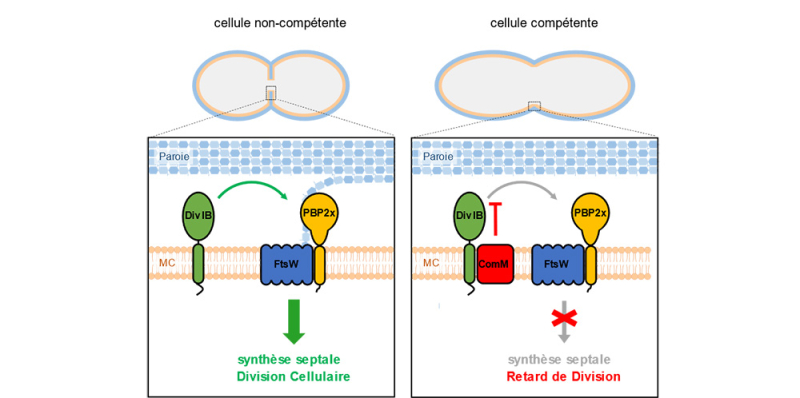
Figure: Model of ComM regulation of septal wall synthesis and division via DivIB. In non-competent cells, DivIB interacts with the septal wall synthesis complex FtsW:PBP2x at the division site. DivIB
activates septal wall synthesis and allows cell division. In competent cells, ComM is expressed and interacts with DivIB to repress its activity, resulting in a slowdown in septal wall synthesis and
delayed cell division. MC: cell membrane.
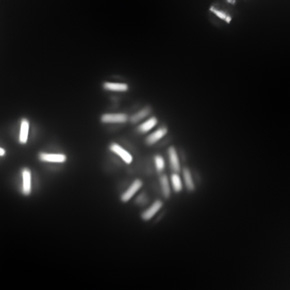
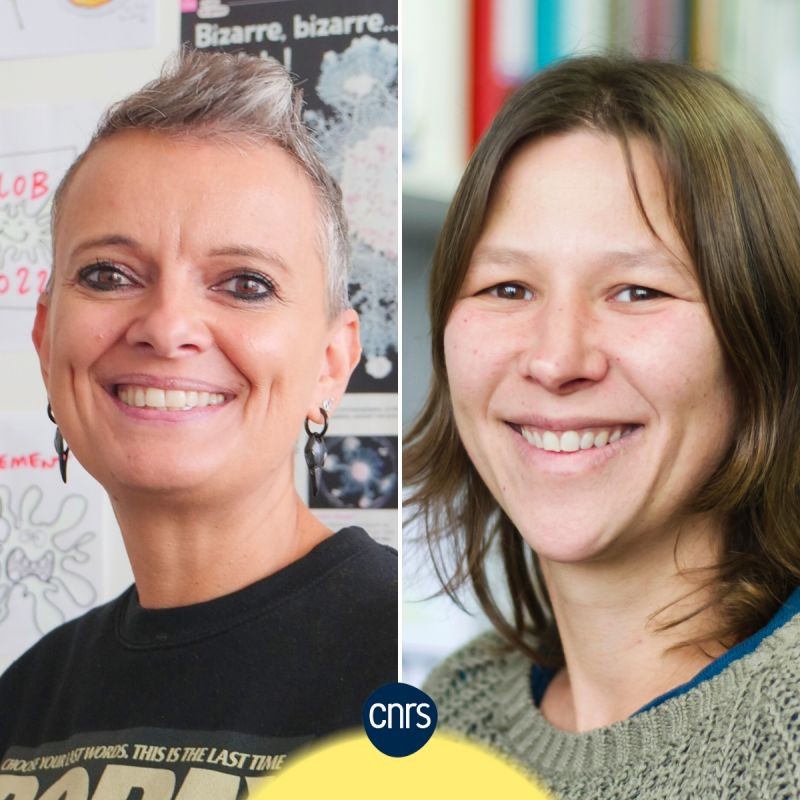
Dimitri Juillot, Isabelle Mortier-Barrière, Patrice Polard and Nathalie Campo (LMGMCBI) and their colleagues are live-streaming their discovery of a novel mechanism that temporarily blocks division in Streptococcus pneumoniae bacteria during natural transformation. This strategic pause allows the bacteria to integrate new genes without compromising the integrity of their genome.
The phenomenon of natural transformation exists in many species and allows them to exchange genes, even between different species. It is an important driver of their diversification, for example to acquire new antibiotic resistances.
In pneumococci, competence is accompanied by a transient blockage of cell division to optimise genetic transformation: the cell cycle is extended by about a third, allowing time for the new DNA to be properly integrated without compromising the integrity of the recipient genome.
The membrane protein ComM, produced during competence, is both necessary and sufficient to induce this blockage.