Team
GSI
Team leader: Fichant Gwennaele
Presentation
Biological systems are the result of a complex evolutionary history, in that partners and/or relationships between them may have been gained, lost or replaced in the course of evolution. Our main research interest is to decipher the evolutionary routes that led to the emergence of these biological processes, taking advantage of the growing number of genomic data from very diverse and complex environments that is enriching our vision of microbial diversity and enabling us to study the complex relationships between organisms and their natural environment.
We conduct studies at different scale: i) at the species level by comparing the genomes of different species strains; ii) at the taxonomic level and iii) at the domain of life level. We also develop statistical and bioinformatics methods adapted to the processing and analysis of RNA 5′-end and 3’end sequencing data. We mainly carried out studies on RNA processing and degradation pathways in Archaea and Bacteria. We started to address the role of Ira proteins in the regulation of RpoS and the General Stress Response (GSR) induced in natural E. coli isolates by the study of Ira diversity in composition, distribution and regulation, to decipher their links with the phenotype and/or genetic background of E. coli strains.
Project 1
In their natural habitat, E. coli bacteria including pathogens must constantly overcome various stresses by triggering the general stress response mediated by the alternative sigma factor RpoS, that regulates the expression of ~500 genes. In addition to its role in bacterial adaptation, RpoS is a key player in virulence, biofilm formation, antibiotic resistance and bacterial persistence which are emerging public health issues. However, our current knowledge on this response is mostly based on studies using laboratory attenuated strains which might minimize the essential adaptative role that RpoS plays in other E. coli strains (i.e commensal, environmental and pathogens). The goal of the IrAdapt project is to explore E. coli natural diversity to enhance our knowledge on RpoS regulation and impact on cell physiology.
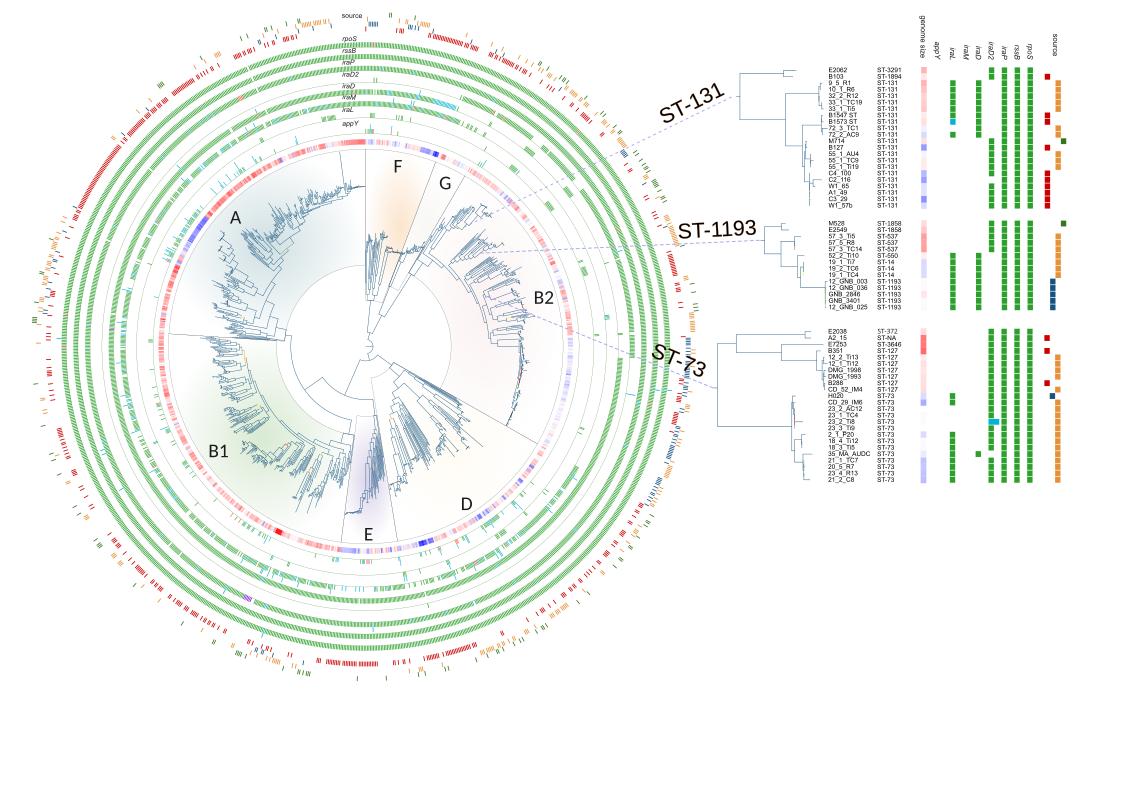
Since an important part of RpoS regulation occurs at the post-translational level, we will comprehensively define the Ira family of anti-adaptor proteins, that stabilizes RpoS and evaluate the consequences of these stabilizations on bacterial fitness and adaptation. We are in charge of a work package which aim is to perform global phylogenomic analyses of ira genes within the E. coli species, to highlight their diversity in composition, distribution and regulation, to decipher their links with the phenotype and/or genetic background of E. coli strains, to infer their evolutionary trajectory. We have initiated a first phylogenetic study using an epidemiologically relevant collection held by Erick Denamur consisting of 1244 strains representative of E. coli diversity in Australia. This preliminary analysis has revealed that the B2 phylogroup has a peculiar ira content.
Project 2
We have a collaboration with the group of Peter Redder to understand how bacteria, here Firmicutes, maintain the correct level of RNA decay. In bacteria, the level of a given mRNA, and the potential for protein expression, is determined by two main factors: transcription and RNA decay. If the transcription machinery is conserved across bacterial phyla, the decay machinery is not. Staphylococcus aureus, Bacillus subtilis and many other Firmicutes do not possess an RNase E homolog but instead encode the endo-ribonuclease RNase Y, and the dual activity 5’ to 3’ exo- and endoribonucleases RNases J1 and J2.
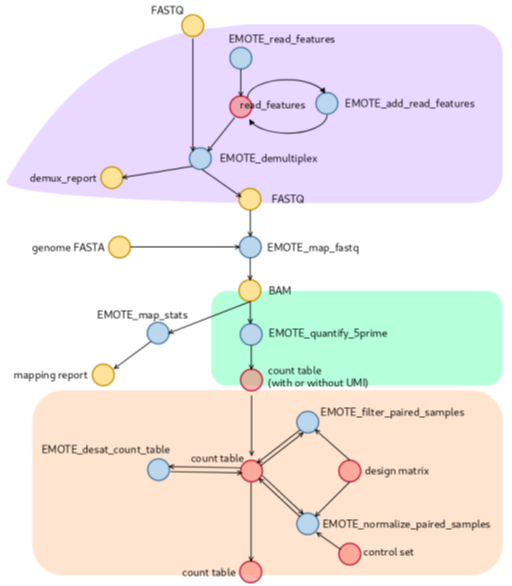
RNase J1 has been shown in vitro to prefer RNAs that are 5′ mono-phosphorylated (5’P) RNAs over identical tri-phosphorylated (5’PPP) RNAs. Therefore, the recently discovered bacterial RNA pyrophosphohydrolases (RPPs), belonging to the large Nudix family, should play a major role in regulating RNA degradation. P. Redder has developed new RNA-Seq protocols to quantify 5′ or 3′ ends of each RNA transcript together with their phosphorylation 5’ end state, which enables tackling new questions such as: i) which of the 5 Nudix from S. aureus, whose functions are unknown, have an RPP activity, ii) identifying in vivo RNase J or RNase Y endo-ribonucleolytic cleavage sites by analyzing the mRNA 5’ and/or 3′ ends, iii) identifying transcription start sites etc.. This requires the development of original workflows and statistical analyses to integrate the specificity of both types of data compared to the established RNA-Seq ones.
– Xu X, Barriot R, Voisin B, Arrowsmith TJ, Usher B, Gutierrez C, Han X, Pagès C, Redder P, Blower TR, Neyrolles O, Genevaux P. Nucleotidyltransferase toxin MenT extends aminoacyl acceptor ends of serine tRNAs to control Mycobacterium tuberculosis growth Nat Commun, 2024 Nov 15(1):9596. doi: 10.1038/s41467-024-53931-w. PMID: 39505885
– Le Scornet A, Jousselin A, Baumas K, Kostova G, Durand S, Poljak L, Barriot R, Coutant E, Pigearias R, Tejero G, Lootvoet J, Péllisier C, Munoz G, Condon C, Redder P. Critical factors for precise and efficient RNA cleavage by RNase Y in Staphylococcus aureus PLoS Genetics, 2024 Aug 1;20(8):e1011349. doi: 10.1371/journal.pgen.1011349. PMID: 39088561
– Batista M*, Langendijk-Genevaux P*, Kwapisz M, Canal I, Phung DK, Plassart L, Capeyrou R, Moalic Y, Jebbar M, Flament D, Fichant G, Bouvier M, Clouet-d’Orval B. Evolutionary and functional insights into the Ski2-like helicase family in Archaea: a comparison of Thermococcales ASH-Ski2 and Hel308 activities NAR Genom Bioinform, 2024 Mar 6(1):lqae026. doi: 10.1093/nargab/lqae026. PMID: 38500564
– Yiying Yang, Haoxiang Chen, Robin A. Corey, Violette Morales, Yves Quentin, Carine Froment, Anne Caumont-Sarcos, Cécile Albenne, Odile Burlet-Schiltz, David Ranava, Phillip J. Stansfeld, Julien Marcoux, Raffaele Ieva. LptM promotes oxidative maturation of the lipopolysaccharide translocon by substrate binding mimicry . Nature Communications, 2023 Oct
– Soussan D, Salze M, Ledormand P, Sauvageot N, Boukerb A, Lesouhaitier O, Fichant G, Rincé A, Quentin Y#, Muller C#. The NagY regulator: A member of the BglG/SacY antiterminator family conserved in Enterococcus faecalis and involved in virulence. Front Microbiol. 2023 13:1070116. doi: 10.3389/fmicb.2022.1070116
– Xu X, Usher B, Gutierrez C, Barriot R, Arrowsmith TJ, Han X, Redder P, Neyrolles O, Blower TR, Genevaux P. MenT nucleotidyltransferase toxins extend tRNA acceptor stems and can be inhibited by asymmetrical antitoxin binding Nat Commun, 2023 Aug 14(1):4644. doi: 10.1038/s41467-023-40264-3. PMID: 37591829
– Tejada-Arranz A, Matos RG, Quentin Y, Bouilloux-Lafont M, Galtier E, Briolat V, Kornobis E, Douché T, Matondo M, Arraiano CM, Raynal B, De Reuse H. RNase R is associated in a functional complex with the RhpA DEAD-box RNA helicase in Helicobacter pylori. Nucleic Acids Res. 2021 49(9):5249-5264. doi: 10.1093/nar/gkab283
– Hajj M*, Langendijk-Genevaux P*, Batista M, Quentin Y, Laurent S, Capeyrou R, Abdel-Razzak Z, Flament D, Chamieh H, Fichant G#, Clouet-d’Orval B#, Bouvier M. Phylogenetic Diversity of Lhr Proteins and Biochemical Activities of the Thermococcales aLhr2 DNA/RNA Helicase. Biomolecules 2021 11(7):950. doi: 10.3390/biom11070950