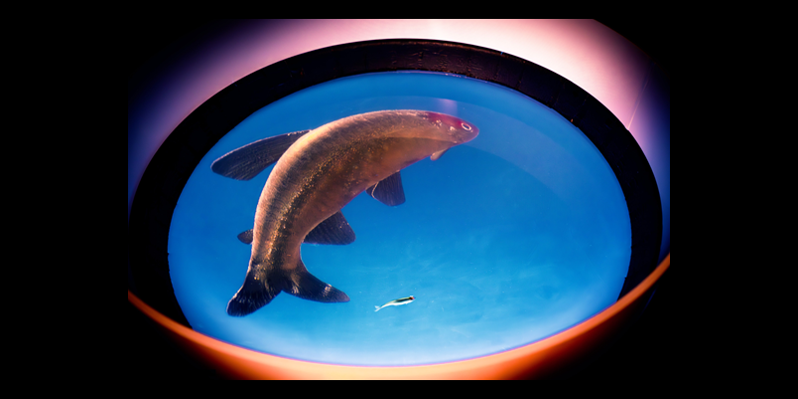
How do fish manage to form schools in which hundreds of individuals swim in a remarkably coordinated manner? Answering this question is one of the major challenges in behavioral biology. To address this, Guy Theraulaz, Ramon Escobedo, Justine Reynaud, and Renaud Bastien (CRCA-CBI) and their collaborators have developed an innovative approach combining mathematical modeling, immersive virtual reality, and animal experimentation.
Their work shows that it is now possible to quantitatively reconstruct the interaction rules that govern collective swimming and then validate them experimentally through real-time interactions between a living fish and its digital twin. They illustrate the emergence of a new generation of experiments combining living organisms and digital agents, in which virtual reality becomes a true laboratory for exploring the fundamental principles of collective intelligence phenomena in the living world, opening up a new avenue for studying collective intelligence and designing bio-inspired systems.